
The Atlas Update
Atlas was deployed on 18 April 2023, 00:00 UTC. Please visit here to read about Houston, the latest protocol upgrade.
This page describes the major changes that Rocket Pool's next major update, titled Atlas, brings to the protocol including updates to both the Smartnode stack and to the Rocket Pool protocol in general.
Please read through this page thoroughly to understand all of the differences between the previous version of Rocket Pool (Redstone) and Atlas.
New Protocol Features
Atlas brings about some exciting new features that are based on both community feedback and changes to the Ethereum protocol itself. Below is a brief list of these changes - click on any of them to learn more about it.
Shapella and Withdrawals
The Ethereum protocol is preparing to undergo its next major upgrade: Shanghai on the Execution layer, and Capella on the Consensus layer - since these are now interconnected, both will occur at the same time. Ethereum users have affectionately come to call the combined upgrade "Shapella" accordingly.
Shapella introduces withdrawals to the Beacon Chain, meaning node operators are now able to access the ETH that is currently locked on the Beacon Chain. This comes in two flavors:
- Partial withdrawals (skimming), where your rewards (your excess Beacon Chain balance over 32 ETH) are sent to your minipool on the Execution Layer. This is done automatically by the protocol itself every so often (about once every four or five days on Mainnet).
- Full withdrawals, where you exit your validator from the Beacon Chain and its entire balance is sent to your minipool on the Execution Layer. This is done automatically by the protocol itself once your validator has been exited from the chain long enough.
Atlas introduces a new delegate contract for minipools that allows node operators to distribute the minipool's ETH balance, splitting it evenly between the node operator and the rETH holders (plus commission, of course) at any time. This gives node operators immediate access to their Beacon Chain rewards! It also puts the rETH holders's share back into the deposit pool, so it can be used to unstake rETH for ETH at the protocol's exchange rate (or to create new minipools).
8-ETH Bonded Minipools
One of the most anticipated changes made in Atlas is the introduction of the ability to only provide 8 ETH to make a minipool instead of 16 ETH. Minipools with only 8 ETH bonded by their owning node operator are matched with 24 ETH from the staking pool (provided by rETH holders) in order to make a validator. This significantly reduces the capital requirement for running your own validator and results in greater returns for both the node operator and the rETH stakers! In fact, running two 8-ETH minipool instead of one 16-ETH minipool will provide over 18% more rewards - even if the 16-ETH minipool has a commission rate of 20%.
Creating an 8 ETH minipool requires that you stake a minimum of 2.4 ETH worth of RPL and a maximum of 12 ETH worth of RPL. These represent 10% of the amount you're borrowing from the protocol, and 150% of the amount you're bonding (staking) yourself.
New minipools can be created with either 8 ETH or 16 ETH. 16 ETH minipools are unchanged from how they work today, and are available for users that want to minimize their exposure to the RPL token.
To learn how to make new minipools using an 8 ETH bond, please visit the minipool creation guide.
Also, once Atlas has been applied, node operators can migrate existing 16-ETH minipools directly into 8-ETH minipool without needing to exit. This will give them 8 ETH back in deposit credit, which can be used to create a new 8-ETH minipool for free!
To learn more about 8-ETH bond minipools, please visit the bond reduction guide.
Solo Validator Conversion
Part of the Shapella upgrade involves the ability for solo validators to change their validators' withdrawal credentials from the original (now unused) BLS-based withdrawal key to an address on the Execution layer. This address will be the recipient for all of that validator's rewards and its full ETH balance once it exits the Beacon Chain.
Regular Rocket Pool node operators don't need to worry about any of this, as the protocol automatically set this up for your minipools when you created them. However, as part of this new requirement for solo validators, Atlas brings an exciting opportunity: the ability to create a special minipool that will become the withdrawal address for your existing solo validator.
In other words, this will allow you to directly convert a solo validator into a Rocket Pool minipool without needing to exit it!
This means you will get all the benefits of Rocket Pool minipools, including:
- The ability to convert your one validator (with a 32 ETH bond) into four minipools (each with an 8 ETH bond), effectively quadrupling your presence on the Beacon Chain
- Commission on the portion of those minipools provided by rETH stakers
- Access to Rocket Pool's Smoothing Pool to pool and evenly distribute rewards from block proposals and MEV
To learn more about converting a solo validator into a minipool, please visit the Converting a Solo Validator into a Minipool guide.
New Smartnode Features
In addition to core changes to the Rocket Pool protocol, Atlas also brings some exciting upgrades to the Smartnode stack itself which are present in v1.9.0.
Automatic Rewards Distributions
If you're already an active Rocket Pool node operator, you may be familiar with the rocketpool_node process that handles certain automated processes.
For example, it ensures you have the correct fee recipient and automatically runs the second stake transaction for you after prelaunch minipools pass the 12-hour scrub check.
Starting with Atlas, the node has a new duty: automatic distribution of minipool rewards!
This is due to the way the Shapella upgrade works, by skimming your rewards from the Beacon Chain into your minipool every few days.
Whenever one of your minipools reaches a balance larger than a user-specified threshold (default of 1 ETH), the node will automatically run distribute-balance on it.
This will send your portion of the rewards to your withdrawal address, and the pool staker's portion back to the deposit pool.
Changing the threshold can be done in the Smartnode and TX Fees section of the service config TUI, under the Auto-Distribute Threshold setting.
Unified Grafana Dashboard
By popular demand, we have created a new Grafana dashboard to help node operators track and assess the status, progress, and overall health of their nodes:
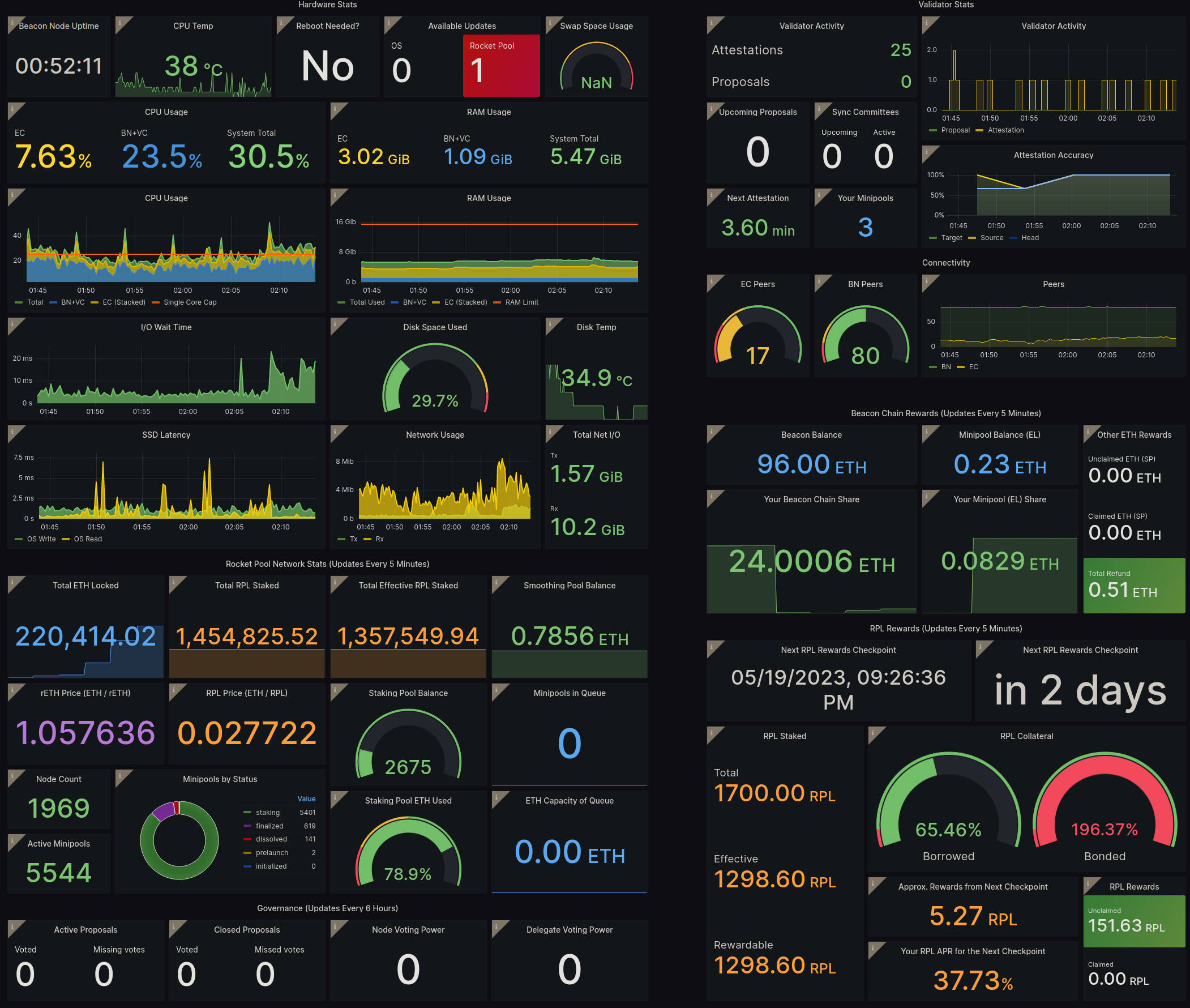
It comes with the following highly requested features:
- Support for all Execution and Consensus clients in a single dashboard - no more changing dashboards based on which clients you're using!
- Execution client stats, including CPU and RAM usage, and peer count
- Attestation accuracy tracking which follows how "correct" your attestations were for the previous epoch, so you know how far off from optimal rewards you're getting
- Tracking of the Smoothing Pool's balance
- Tracking of claimed and unclaimed rewards, now including ETH from the Smoothing Pool
- Stats about Rocket Pool's Snapshot-based governance votes
- Room for tracking a second SSD's used space and temperature if you have one for your OS and a different one for your chain data
- And more!
You can import the new dashboard from the official Grafana service using ID 21863 by following our Grafana guide.
This new dashboard was a labor of love that involved extensive help from community member 0xFornax - thank you for all of your hard work!
Nimbus Changes
Smartnode v1.9.0 introduces split mode support for Nimbus! Instead of running the Beacon Node and Validator Client inside a single process / container, the Smartnode will now run them in separate containers like the other clients. This has the following benefits:
- Nimbus now supports fallback clients (a secondary Execution client and Beacon Node that Nimbus's Validator Client can connect to when your primary clients are down for maintenance, such as resyncing).
- Nimbus is now supported in Externally-Managed (Hybrid) Mode, so you can couple the Validator Client that the Smartnode manages to an external Beacon Node that you maintain on your own.
- The Beacon Node no longer needs to be restarted after the addition of new minipools, meaning you don't lose attestations while it reconnects to its peers.
Lodestar Support
Lodestar is now supported as an option for your Consensus Client of choice! This is the newest addition to be officially accepted onto Ethereum's Launchpad, and it's ready for validation. Lodestar supports many of the great features you've come to love from the other clients, including Doppelganger Detection, MEV-Boost, externally-managed clients (Hybrid Mode), and more!
New Network Snapshot System
On a slightly more technical note, v1.9.0 introduces a brand new system for quickly capturing a snapshot of the state of everything about your node on both the Execution and the Consensus layers. Under the hood, this system leverages MakerDAO's multicall contract and Will O'Beirne's Ethereum Balance Checker contract to batch thousands of individual Execution client queries up into a single request.
This makes the node process much less taxing on the Execution client for node operators with a large number of validators, and should significantly reduce its CPU load which will improve attestations and overall rewards.
This new system hasn't made its way into the CLI itself yet, so any commands you run there (such as rocketpool minipool status) will still use the old single-query setup.
Over time we'll introduce it into the CLI too, which will make all of its commands lightning fast (except for waiting for transactions to be validated, that still takes a while).